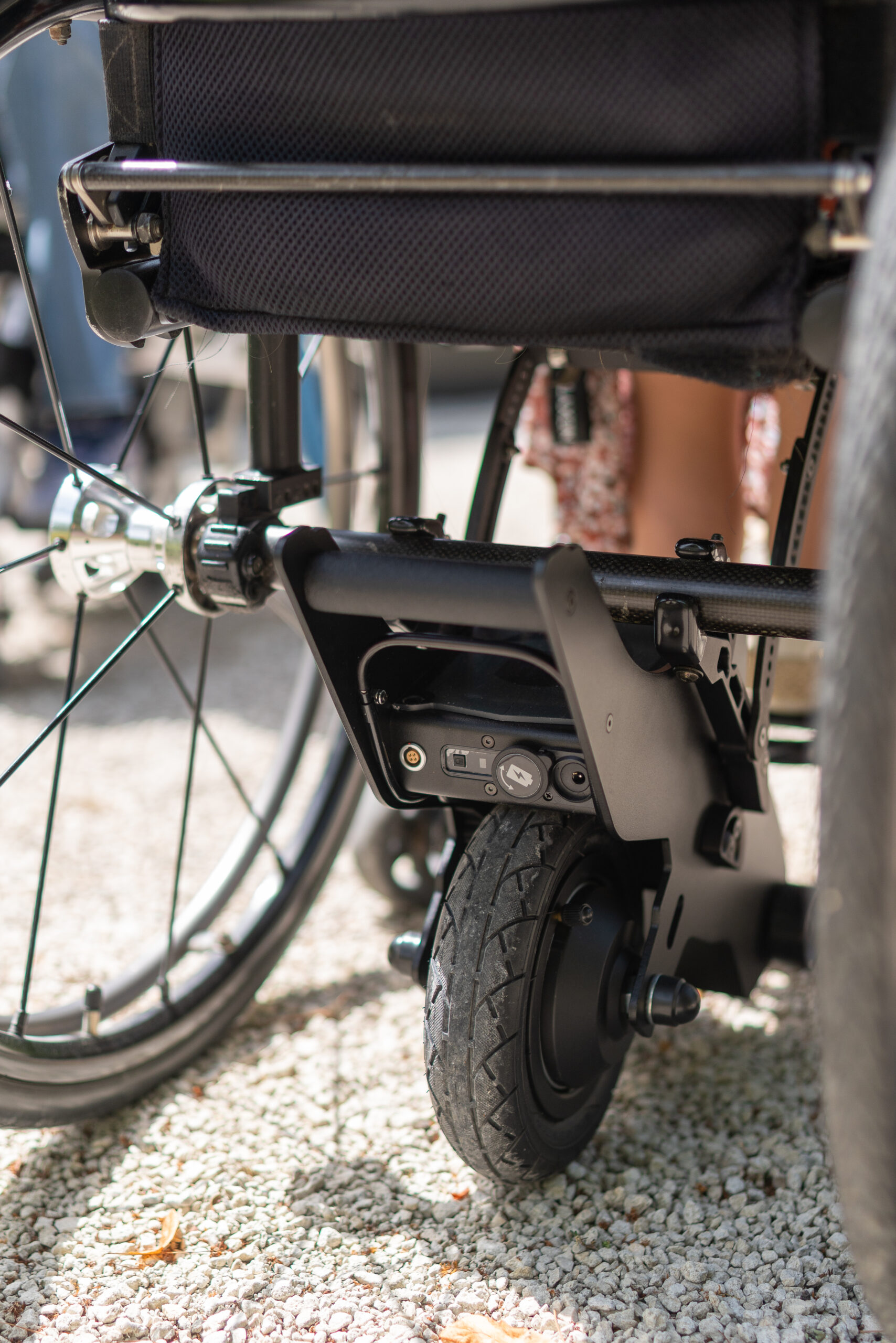

Front, Mid or Rear Wheel Drive Configurations?
Choosing between front, mid, and rear‑wheel drive configurations is a critical decision when selecting a power wheelchair—it shapes your maneuverability, comfort, and how the chair handles various environments. Here’s a breakdown of each configuration and guidance to help you find the best fit.


Front‑Wheel Drive (FWD)
Pros:
-
Excellent obstacle clearance: The drive wheels lead the way, pulling the chair over curbs and uneven terrain smoothly
-
Better traction on diverse surfaces: With force distributed across fewer wheels, FWD improves traction .
-
Functional indoors: Easier 90° turns, and allows closer approach to counters and fixtures due to rear casters.
-
Smoother ride: Four wheels on the ground means fewer bumps and less vibration compared to other configurations.
Cons:
-
Learning curve: Some users find it tougher to master, especially due to rear “fishtailing”.
-
Directional stability at speed: Can be less stable—higher tendency to feel unsteady at higher speeds.
Mid‑Wheel Drive (MWD)
Pros:
-
Tightest turning radius: With the drive wheel central to the chair, it allows for smooth 360° turns and excellent indoor navigation.
-
Highly intuitive to operate: Many describe it as turning naturally, similar to walking—excellent for new users or individuals with perceptual impairments.
-
Balanced stability: Supported by castors front and back for steadiness in transitions and straight paths.
Cons:
-
Rough ride on uneven terrain: Smaller castors may struggle over obstacles, leading to bumps—though improved suspension systems can mitigate this.
-
Limited front access: Less ability to get close to surfaces compared to FWD.
Rear‑Wheel Drive (RWD)
Pros:
-
Superior ride comfort outdoors: Offers good suspension and smoother ride over rough surfaces.
-
Stable at speed: Weight distribution over drive wheels enhances directional control at high speed.
-
Intuitive for drivers with vehicle experience: Similar drive feel for those familiar with rear‑wheel drive cars.
Cons:
-
Wide turning radius: Less agile indoors and in tight spaces, often requiring multi-point turns.
-
Obstacle clearance challenges: Casters at the front complicate climbing over objects.
-
Limited access to frontal surfaces: Harder to align closely with counters or tables.
So, Which One Is Right for You?
-
Indoor living, tight spaces: Mid‑wheel drive offers the agility and ease of use that many find ideal, especially in tight hallways or doorways.
-
Mixed indoor/outdoor with obstacles: Front‑wheel drive combines solid obstacle clearance with good indoor performance—best for users needing greater versatility.
-
Predominantly outdoor or long-distance use: Rear‑wheel drive excels in comfort and stability over varied terrains and may feel most natural to those familiar with driving vehicles.
Final Thoughts & Recommendations
Your ideal choice depends on a combination of factors:
-
Environment: Home layout, outdoor paths, curb height, tight corners.
-
User experience: Familiarity, cognitive/perceptual skills, fatigue sensitivity.
-
Functional needs: Desire to access surfaces, ability to handle bumps, or preference for a smoother ride.
-
Equipment training and trials: As Permobil emphasizes, real-world trials in both clinical and home settings are essential before finalizing a choice
Choosing the right drive configuration is a deeply personal decision—what’s most important is finding a configuration that maximizes independence, comfort, and quality of life. Let me know if you’d like to dive deeper into how seat functions or specific Permobil models align with each drive type!

Powerchairs

When to Consider an Off-Road Powerchairs